
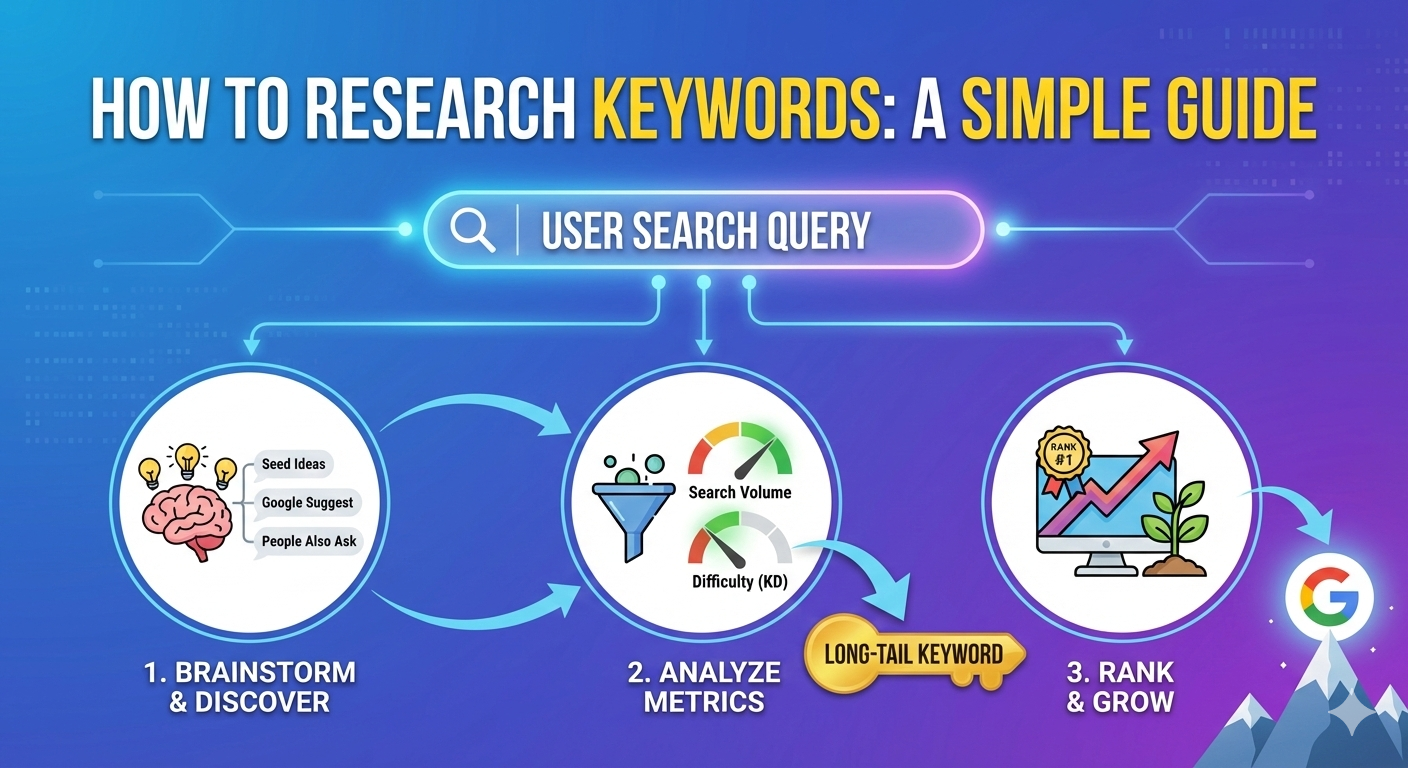
This is where Keyword Research comes in. It is the foundation of SEO (Search Engine Optimization). If content is the kingdom, then keywords are the keys to the castle gates.
If you don't know what words your potential readers are typing into Google, you are just guessing. And guessing doesn't get you ranked on page one.
In this guide, I will walk you through exactly how to research keywords in 5 simple steps, even if you are a complete beginner.
What is Keyword Research (And Why Should You Care?)
Simply put, keyword research is the process of finding the exact words and phrases (queries) that people use in search engines like Google.
Why is this vital for AdSense and SEO?
- Traffic: You stop writing "blind" and start writing topics people want.
- Ad Revenue: High-quality keywords attract better advertisers, which can increase your AdSense earnings.
- Understanding Intent: It helps you understand why someone is searching. Are they looking to buy something, or just looking for information?
Step 1: Start with Your "Seed" Ideas (Brainstorming)
Before you open any fancy SEO tools, use your brain. You know your niche better than anyone else.
Sit down and think: If I were looking for my own product or website, what would I type into Google?
Let's say your website is about "Healthy Cooking." Your "seed" keywords might be:
- Healthy recipes
- Easy dinner ideas
- Low-carb meals
- Meal prepping
These are broad topics. They are too competitive to rank for right away, but they are the starting point for finding better, deeper keywords.
Here is a fully SEO-Optimized, AdSense-Friendly, and Human-Written blog post about keyword research.
Just like the previous post, this is written in a conversational, easy-to-understand tone, perfect for beginners, while satisfying Google's requirements for high-quality content.
Step 1: Start with Your "Seed" Ideas (Brainstorming)
Before you open any fancy SEO tools, use your brain. You know your niche better than anyone else.
Sit down and think: If I were looking for my own product or website, what would I type into Google?
Let's say your website is about "Healthy Cooking." Your "seed" keywords might be:
- Healthy recipes
- Easy dinner ideas
- Low-carb meals
- Meal prepping
These are broad topics. They are too competitive to rank for right away, but they are the starting point for finding better, deeper keywords.
Step 2: Use Free Tools to Expand Your List
Now that you have your seeds, let's plant them and watch them grow. You don't need expensive software right now; Google itself is the best free tool.
A. Google Auto-Suggest
Go to Google and type in one of your seed keywords, but don't press enter. Look at the suggestions Google drops down.
If you type "Healthy recipes for...", Google might suggest:
- ...for weight loss
- ...for kids
- ...for dinner on a budget
These are golden keywords because Google is literally telling you, "Lots of people search for this!"
B. "People Also Ask" Section
When you search for something, scroll down a bit. You will see a box called "People also ask."
These are actual questions users are asking related to your topic. If you can write a blog post that specifically answers these questions, you have a great chance of ranking.
Step 3: The Secret Sauce – "Long-Tail Keywords"
This is the most important concept for beginners.
- Short-Tail Keyword: "Shoes" (Very broad, high competition, hard to rank).
- Long-Tail Keyword: "Best women's running shoes for flat feet 2025" (Specific, lower competition, easier to rank).
Why Long-Tail Keywords Win: A person searching for just "shoes" could be looking for anything—pictures of shoes, history of shoes, or buying shoes.
But a person searching for the long-tail version knows exactly what they want. If you write content matching that specific search, they are much more likely to click on your site and stay there.
Step 4: Understanding Keyword Metrics (Volume vs. Difficulty)
Once you have a list of potential keywords from Steps 2 and 3, how do you know which ones to choose?
You need to use an SEO tool (like Ubersuggest's free version, Ahrefs' free generator, or SEMrush) to look at two crucial metrics:
1. Search Volume
This tells you roughly how many people search for that keyword per month.
- Mistake: Beginners only chase the highest volume numbers (e.g., 50,000 searches a month).
2. Keyword Difficulty (KD) / SEO Difficulty (SD)
This is a score (usually from 0 to 100) indicating how hard it is to rank on page 1 for that term.
- 0-20: Easy (Go for these!)
- 21-50: Medium (Possible with good content)
- 51-100: Hard (Avoid for now)
The Sweet Spot: As a new website, your goal is to find keywords with decent volume (maybe 100–1,000 searches a month) and low difficulty (under 30 SD). These are your easiest wins.
Here is a fully SEO-Optimized, AdSense-Friendly, and Human-Written blog post about keyword research.
Just like the previous post, this is written in a conversational, easy-to-understand tone, perfect for beginners, while satisfying Google's requirements for high-quality content.
Post Title:
Step 3: The Secret Sauce – "Long-Tail Keywords"
This is the most important concept for beginners.
- Short-Tail Keyword: "Shoes" (Very broad, high competition, hard to rank).
- Long-Tail Keyword: "Best women's running shoes for flat feet 2025" (Specific, lower competition, easier to rank).
Why Long-Tail Keywords Win: A person searching for just "shoes" could be looking for anything—pictures of shoes, history of shoes, or buying shoes.
But a person searching for the long-tail version knows exactly what they want. If you write content matching that specific search, they are much more likely to click on your site and stay there.
Pro Tip: Aim for keywords that are usually 4+ words long.
Step 4: Understanding Keyword Metrics (Volume vs. Difficulty)
Once you have a list of potential keywords from Steps 2 and 3, how do you know which ones to choose?
You need to use an SEO tool (like Ubersuggest's free version, Ahrefs' free generator, or SEMrush) to look at two crucial metrics:
1. Search Volume
This tells you roughly how many people search for that keyword per month.
- Mistake: Beginners only chase the highest volume numbers (e.g., 50,000 searches a month).
2. Keyword Difficulty (KD) / SEO Difficulty (SD)
This is a score (usually from 0 to 100) indicating how hard it is to rank on page 1 for that term.
- 0-20: Easy (Go for these!)
- 21-50: Medium (Possible with good content)
- 51-100: Hard (Avoid for now)
The Sweet Spot: As a new website, your goal is to find keywords with decent volume (maybe 100–1,000 searches a month) and low difficulty (under 30 SD). These are your easiest wins.
Step 5: Analyze Your Competitors
Why reinvent the wheel? Take a look at what is already working for others in your niche.
- Type your potential keyword into Google.
- Open the top 3 to 5 results (ignore the ads).
- Look at their articles. How long are they? What headings (H2, H3) are they using? Do they have images or videos?
Your goal is not to copy them. Your goal is to see what Google considers the "best" answer, and then create something even better and more comprehensive.
Conclusion
Keyword research might seem technical at first, but it’s really just about understanding people. It's about figuring out the questions your audience is asking and then providing the best possible answers.
Don't rush this process. Spend quality time finding the right "long-tail" keywords with low difficulty.
If you target the right keywords, you won't have to beg for traffic—Google will send it to you automatically.
(FAQs)
Q1: Can I do keyword research for free? A: Yes, absolutely. You can get very far using Google Auto-Suggest, the "People Also Ask" section, and free versions of tools like Ubersuggest or the Google Keyword Planner (if you have a Google Ads account).
Q2: How many keywords should I target in one blog post? A: Focus on one primary keyword that goes in your title and first paragraph. Then, sprinkle in 3–5 related "secondary keywords" naturally throughout the rest of the content. Don't "stuff" keywords; write for humans first.
Q3: What if a keyword has zero search volume? A: Sometimes tools are wrong. If you think a topic is valuable to your audience, write it anyway! Sometimes zero-volume keywords are just very new topics that will grow later.
Q4: How often should I do keyword research? A: You should do it every time you plan a new batch of content. Trends change, and people search for new things constantly.
Q5: Why am I not ranking even though I used a good keyword? A: Finding the keyword is only step one. You also need to write high-quality content, ensure your site loads fast, and build backlinks (as discussed in our previous guide!). SEO takes patience—it often takes 3-6 months to see real results.